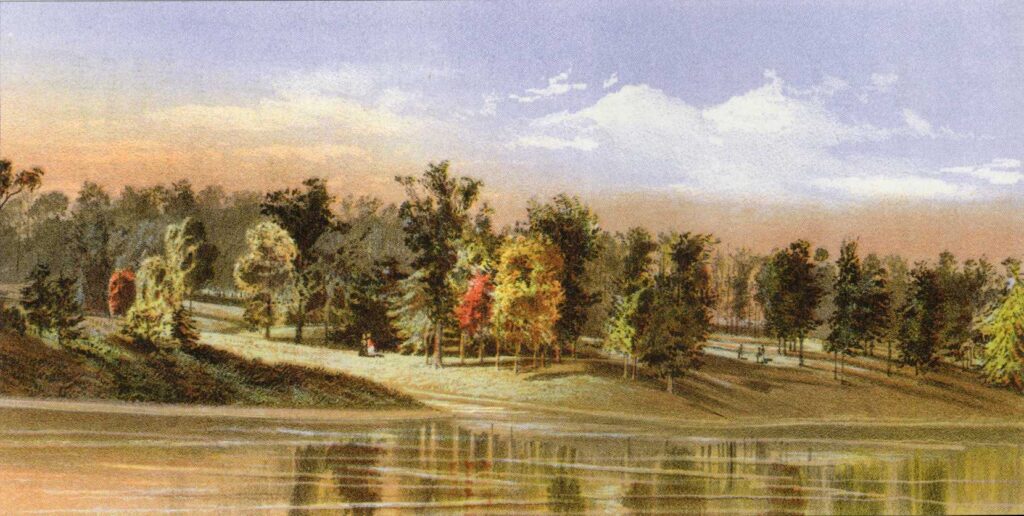
America’s oldest coordinated system of public parks and parkways is the system in Buffalo, New York designed by Frederick Law Olmsted and his partners beginning in 1868. The pioneering design for Buffalo created by renowned landscape architect Frederick Law Olmsted (1822-1903) and his partner Calvert Vaux (1824–1895) consisted of three public grounds: a very large park featuring a naturalistic landscape; a public ceremonial space; and a military drill ground. He also incorporated into his overall plan an existing city park space, the “prospect hill parks” straddling Niagara street at Porter avenue. All of these grounds were connected by broad “parkways” from which all commercial activities, including commercial traffic, were excluded. The parkways served to form green corridors which would extend the park experience throughout the city. Their associated “circles” placed green “islands” at prominent street intersections, interrupting the linear view down seeming endless the thoroughfares and bringing a sense of scale and nature to the environment.
Olmsted, working with several partners during his career, continued to design public grounds for the rapidly expanding city. He worked with the Buffalo Board of Park Commissioners, the state chartered commission which built and maintained those grounds placed by law under their purview. The commissioners, unpaid positions serving for set terms, were appointed by the city’s mayor (who was ex officio member) after approval by the city council. After Mr. Olmsted’s retirement from active practice in 1897 due to declining health, his sons assumed control of his firm and continued a relationship with Buffalo that ran through 1915. In that year, the city’s governmental structure was completely overhauled via a new state charter; one change was that its independent Board of Park Commissioners was dissolved.
Today the majority of Olmsted’s designs in Buffalo are substantially intact. They represent one of the largest bodies of work by the master landscape architect. The Olmsted designed portions of the Buffalo park system have been listed on the National Register of Historic Places.
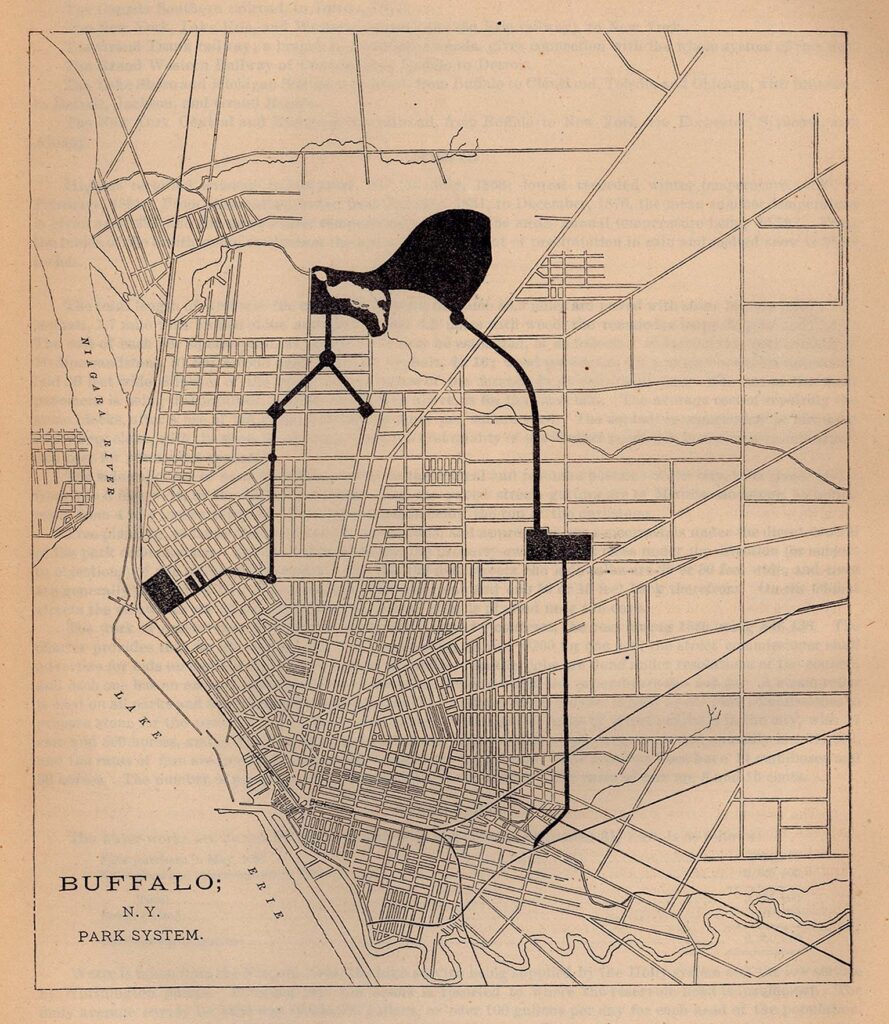
The Original Parks and Parkways System
- Parks and Pleasure Grounds:
- The Park (now Delaware Park)
- The Front (now Front Park)
- The Parade (redesigned by Olmsted as Humboldt Park in 1896, now Dr. Martin Luther King, Jr. Park)
- Park Approaches:
- Parkways:
- Humboldt Parkway (destroyed by construction of the Kensington Expressway)
- Lincoln Parkway
- Chapin Parkway
- Bidwell Parkway
- Avenues:
- The Avenue (now Richmond avenue)
- Porter Avenue
- Fillmore Avenue (originally East Side Boulevard, partially completed to William street, but removed from Parks Board control and opened to commercial use in 1906)
- Places and Circles:
- Soldier’s Place (now Soldier’s Circle)
- Bidwell Place (now Colonial Circle)
- Chapin Place (now Gates Circle, central portion and fountain redesigned in 1902 by Green & Wicks)
- The Circle (now Symphony Circle)
- Agassiz Circle (heavily modified with the center island lost)
- Ferry Street Circle (at Richmond avenue, center island restored in 2002)
- “The Bank” (a circle at Niagara and Wadsworth streets and Massachusetts and Busti avenues, lost)
- Parkways:
- Smaller Grounds:
- Prospect Hill Parks (now Prospect Park)
Later Olmsted-designed additions to the system
- Minor Parks:
- Day’s Park
- The Terrace (lost)
- Masten Place (lost)
- Bennett Place (later Bennett Park, lost)
- Southern Parks:
- South Side Parks:
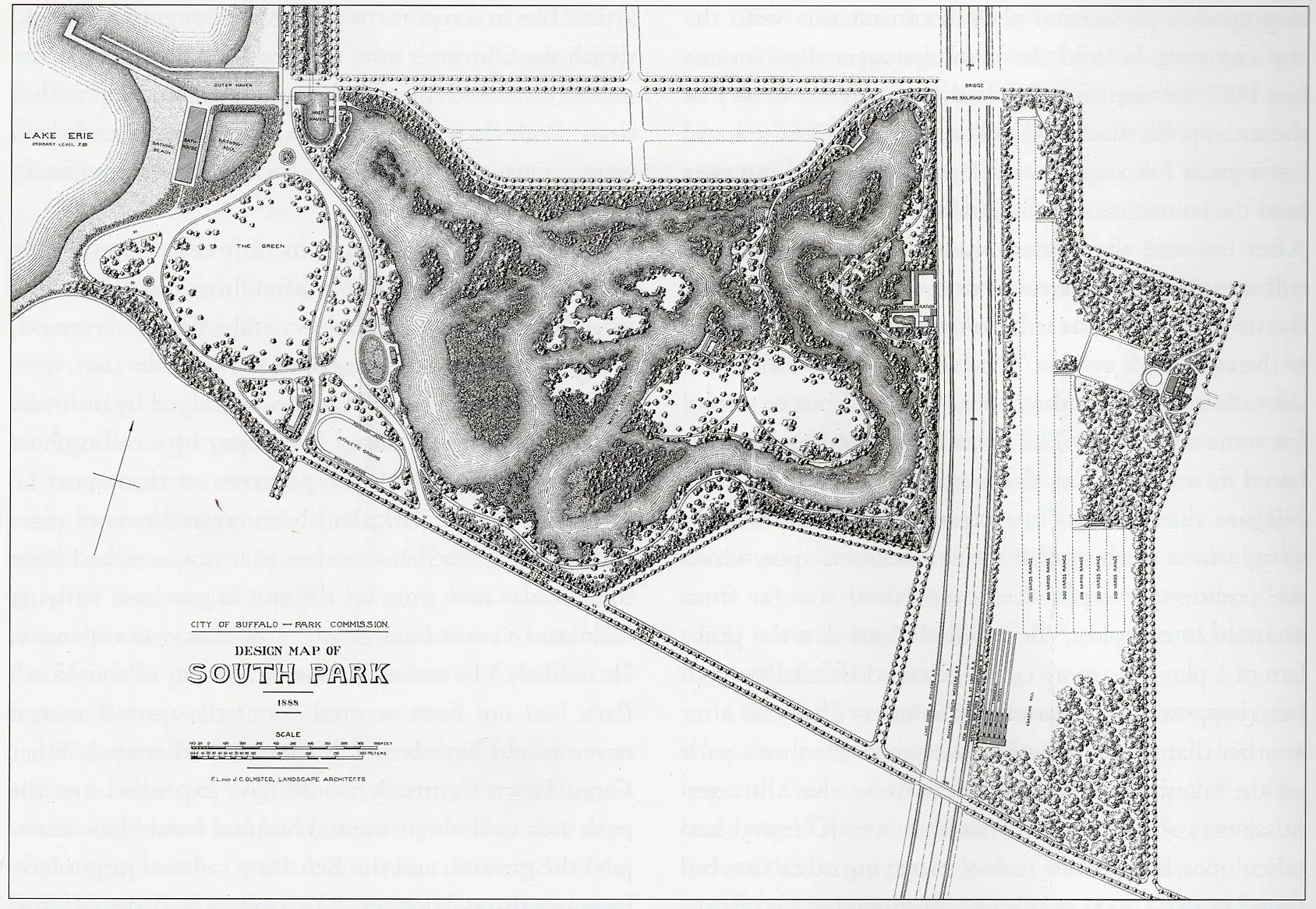
- South Park
- Cazenovia Park
- Heacock Park (now Heacock Place; an existing park, not designed by Olmsted, but incorporated into the Southern Parkways design)
- Southern Park Approaches: (conceptual designs by Olmsted, implemented by the staff of the Parks Commission)
- Southern Parkways:
- South Side Parkway (now McKinley Parkway)
- Red Jacket Parkway
- Southern Circles:
- Woodside Circle (now McClellan Circle)
- South Side Circle (now McKinley Circle, partially constructed, not completed until 2002)
- Southern Parkways:
- South Side Parks:
- Northern Parks:
- Northern Park:
- Northern Park Approaches: (conceptual design, partially implemented by Parks Board staff)
- Northern Parkways:
- Scajaquada Parkway (destroyed by construction of the Scajaquada Expressway)
- Roesch Avenue (planned, but not constructed)
- Northern Parkways:
Other Olmsted Projects In Buffalo
- Parkside subdivision, 1872-1886 (partially completed)
- Parkside Land and Improvement Company, 1886 (developers of Highland Parkside neighborhood.)
- Hyde Park Land Syndicate, 1885-1890 (developers of western portion of Parkside tract) (plans not located)
- New York State Asylum for the Insane (now the Buffalo Psychiatric Center, the Richardson-Olmsted Complex, and Buffalo State University), ca. 1877 (partially destroyed by building additions).
- Niagara Square, 1874 (not constructed?), design reworked, 1895 (not constructed)
- City and County Hall (now Old Erie County Hall), 1875-1878 (the grounds facing Delaware Avenue were destroyed in 1963 by a building addition).
- Lafayette Square, ca. 1883 (landscape design for monument) (destroyed by a street realignment project in 1913).
- Villa Park subdivision, 1885-1887 (for Villa Park Land Company, Ltd., ) (street plan intact)
- South Park (original proposal), 1886 (not constructed)
- Additions to the Front, 1887-1891 (partially constructed, lost)
- Buffalo Civic Center, 1919 (not constructed)
- Several residential premises in the city.
Additional Olmsted Projects Near Buffalo
Olmsted also worked on a number of projects in communities close to Buffalo. Among them were the Point Chatauqua community, the Niagara Reservation in Niagara Falls, planning for the village of Depew, parks in Rochester, as well as commissions in East Aurora, Niagara Falls, N.Y., Niagara Falls, Ontario, and St. Catherines, Ontario.
260531